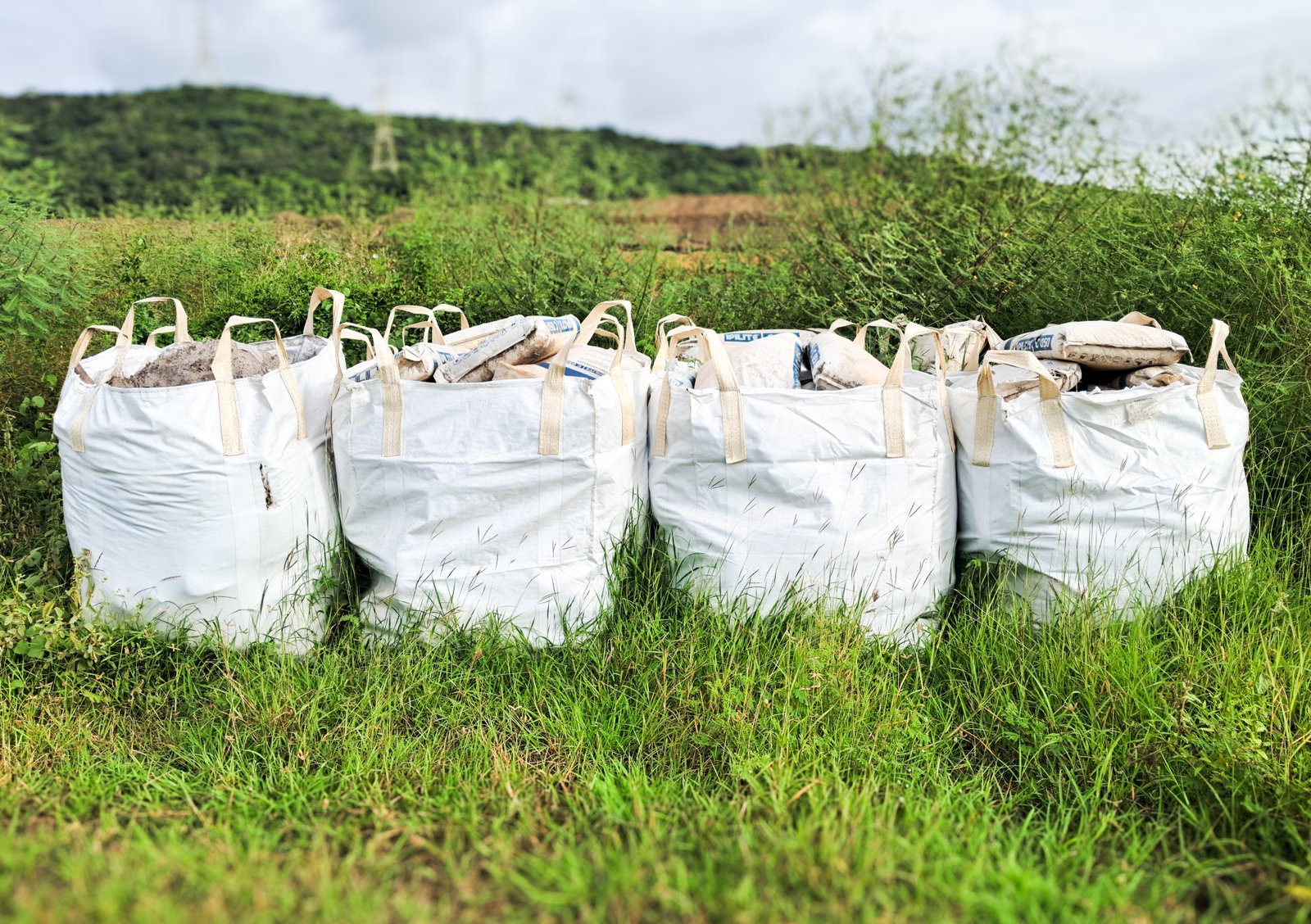
A cement producer handling fine powder needs a different packaging specification from a food processor shipping sugar or a farm business storing seeds. Their moisture sensitivity, flow behaviour and contamination requirements differ.
Choosing FIBC bags for bulk packaging starts with the product and handling process. Bag dimensions, safe working load, fabric construction, seams, liners and discharge arrangements should work together as an approved packaging system.
What Are FIBC Bags?
FIBC stands for Flexible Intermediate Bulk Container. Also called jumbo bags or industrial bulk bags, these bags typically use woven polypropylene fabric with integrated lifting loops. They are widely used for dry, flowable materials such as powders, grains and granules.
FIBCs are designed for mechanical handling, so their construction must suit the contents, lifting equipment and filling and discharge arrangements.
Explore Isha Technologies’ FIBC jumbo bag range when preparing an application-specific packaging brief.
FIBC Bags for Cement
Cement packaging must address fine-particle escape and moisture exposure. When selecting FIBC bags for cement, review:
- Sift-resistant seams to reduce powder escape.
- Coatings and liners for required moisture protection.
- Filling spouts matched to filling equipment.
- Discharge outlets suited to receiving equipment.
- Safe working load for the actual filled mass.
Moisture protection depends on the complete system, including closures, seams, liner integrity and storage conditions. A liner cannot compensate for unsuitable storage or incorrect closure.
FIBC Bags for Chemicals
Chemical powders, resin pellets and mineral additives require specifications based on the exact product. For FIBC bags for chemicals, assess compatibility between the cargo and fabric, coating, liner, sewing thread and closures. Share the safety data sheet, product temperature, particle characteristics and storage conditions with the supplier.
Filling and emptying can generate electrostatic charge. Type C FIBCs use conductive elements and require grounding during filling and emptying. Type D bags use a different static-protective design and do not require bag grounding, subject to their conditions and limitations.
Where cargo is classified as dangerous goods, confirm that the approved packaging design covers the particular product and transport conditions.
FIBC Bags for Agriculture
Agricultural bulk packaging covers grains, seeds, animal feed and fertilisers. FIBC bags for agriculture should be selected according to product moisture, airflow requirements, contamination sensitivity and storage duration.
For grains and seeds, review moisture protection, closure integrity and cleanliness. Selected produce may require ventilated construction. Fertilisers and crop-treatment materials may require chemical compatibility and hazardous-material assessments and should not automatically use the same specification as food crops.
Food Grade FIBC Bags
Food ingredients such as sugar, salt, flour and starch can be packed in appropriately specified FIBCs. However, food grade FIBC bags require more than a particular resin or liner.
Review food-contact documentation, suitability for the food type and contact conditions, hygiene controls, traceability, liner and closure arrangements, and cross-contact controls where applicable.
Request declarations and supporting evidence for the destination market. Food-contact compliance should be established through appropriate documentation rather than simply describing a bag as “FDA approved.”
How to Specify Industrial Bulk Bags
The specification should translate product properties into measurable requirements.
Required product volume = target fill mass ÷ bulk density
For example, 1,000 kg of material with a bulk density of 800 kg/m³ occupies approximately 1.25 m³. This is product volume, not final bag dimensions.
Confirm the safe working load for the actual filled mass and specify filling and discharge spout dimensions, lifting-loop arrangements and equipment clearances.
Request dimensional tolerances, construction details and relevant test evidence before bulk production. A fabric tensile result alone does not establish complete-bag performance.
Storage, Handling and Reuse
Store bags protected from moisture, sunlight and damage. Follow lifting instructions, inspect bags before use and keep personnel clear of suspended loads.
Do not assume an emptied bag can be reused. Reuse depends on bag design, condition, intended application and approved inspection or reconditioning processes.
Prepare Your Packaging Brief
Before requesting a quotation, provide:
- Product name, safety data and bulk density.
- Target fill mass and filling temperature.
- Particle size, moisture sensitivity and flow behaviour.
- Filling, lifting and discharge equipment details.
- Storage conditions and destination market.
- Food-contact, electrostatic or dangerous-goods requirements.
- Order quantity and delivery schedule.
Request a sample and approved drawing before bulk production to evaluate equipment fit, closure operation and discharge performance.